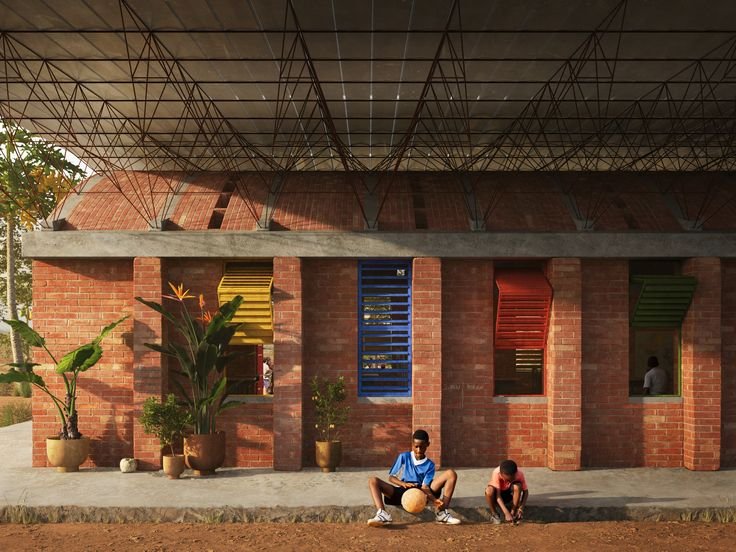
In cities like Niamey, a silent contradiction shapes everyday life: we live in one of the hottest, driest climates on earth, yet many of our buildings are designed as if we lived somewhere else. Glass façades trap heat, thin concrete walls absorb and radiate it, and air conditioning becomes a necessity rather than a choice. The result is not only discomfort, but also high energy costs, unsustainable construction practices, and a growing disconnect between people and their environment.
This problem did not appear by accident. It is the result of decades of imported architectural models, designs inspired by Europe, the Middle East, or globalized urban trends applied without adaptation to the Sahelian context. In trying to appear “modern,” many developments have abandoned the intelligence embedded in traditional architecture. Yet long before mechanical cooling systems existed, communities across Niger had already mastered the art of building for extreme climates. Thick earthen walls, internal courtyards, shaded openings, and compact urban forms were not aesthetic choices; they were survival strategies.
At the heart of the issue is a misunderstanding of what modernity should mean. Modern architecture in Niger has too often been reduced to materials like concrete, glass, and steel, symbols of progress that, in reality, perform poorly under intense heat. A concrete house exposed to the sun all day becomes an oven by afternoon. Large unshaded windows increase solar gain. Flat roofs without insulation trap heat indoors. These buildings then rely heavily on electricity for cooling, creating a cycle of dependency that is both economically and environmentally unsustainable.
Ironically, the solutions we need already exist. They are rooted in what we now call Architecture bioclimatique which is an approach that designs buildings in harmony with their environment. In Niger, this means rethinking orientation, materials, and spatial organization. Buildings should be positioned to minimize direct sun exposure, with openings carefully placed to encourage natural ventilation. Shading devices—such as overhangs, screens, and vegetation should be integrated from the start. Walls should be thick enough to delay heat transfer, using materials like stabilized earth that regulate indoor temperatures naturally.
Traditional Sahelian architecture offers a powerful blueprint. Structures such as those found in Ville d’Agadez demonstrate how urban form, material, and climate can work together. Narrow streets create shade, earthen buildings maintain cool interiors, and communal spaces foster both social life and environmental comfort. These are not relics of the past, they are models for the future.
Fixing the problem requires more than technical adjustments; it demands a shift in mindset. Architects, developers, and policymakers must redefine what “quality” and “progress” look like. Instead of copying foreign aesthetics, we must invest in research, training, and innovation rooted in local realities. This includes developing modern construction techniques using local materials, updating building codes to reflect climatic needs, and educating clients about the long-term benefits of climate-responsive design.
There is also a social dimension. Today, many Nigeriens live in poorly constructed housing not by choice, but by necessity. By rethinking design with affordability and climate in mind, it is possible to create housing that is both accessible and dignified. Well-designed, low-cost homes using local materials can significantly improve living conditions while reducing energy consumption.
Ultimately, the question is not whether Niger can build differently but is whether it chooses to. The knowledge is already here. The urgency is real. In a time of rising temperatures and rapid urbanization, continuing to build against the climate is no longer an option. The future of architecture in Niger lies in rediscovering its own intelligence, and transforming it into a new standard; one where buildings do not fight the environment, but work with it.
Leave a Reply